


Back On Track
Back On Track
Words by Like the Wind – Photography supplied by ASICS
The World Athletics Championships in Tokyo offered redemption

In the Japan National Stadium, there is an architectural detail that’s hard to spot when the space is packed with 65,000 athletics fans. But in quiet moments, when the stadium is empty, the spattering of different-coloured seats is striking – and that is no accident. There is a good reason for why the chairs were designed this way. Two good reasons, in fact.
When Tokyo won the right to host the 2020 Olympic Games, there was discussion about whether the city – and the nation – needed a new stadium. In the end, the decision was taken to replace the original home of athletics with a new one. The whole project, from the choice of architect to the design and the cost, was not without its critics. But the government was adamant that the crowds expected to flock to the city for the XXXII Olympic Games should be welcomed to a new home for the opening and closing ceremonies, as well as for the track and field competitions.
Initially, the project was awarded to Zaha Hadid, who had designed the London Aquatics Centre for the 2012 Olympic Games. But problems – and cost increases, in particular – started to generate an ever-fiercer backlash from the community. Eventually a new architect, Kengo Kuma, was chosen for the project and his pared-back design was approved. With a new stadium being built and excitement for the Games growing around the world, it seemed like the Tokyo Olympic Games would be a huge success.
Then, the Covid-19 pandemic flipped everything upside down. The Games had to be delayed by a year. And even with the delay, the stadia for all the Olympic events had to be empty.
The disappointment felt by the Japanese Olympic Committee, the athletes and the fans was huge. But one of Kuma’s design decisions would have an unexpected positive consequence.
Kuma’s concept from the outset was to build a stadium that felt like it was in a forest. This was most notably embodied by the huge wooden beams, cut from Japanese timber, which made up the roof and much of the structure. It was also found in the seating, which was bolted in place in an apparently random smattering of greens, browns and beige, shifting from darker shades close to the track to lighter shades up near the roof.
This represents the way light changes in a forest. What this trick of the eye also managed to do was give people watching the action on their televisions the sense that the stadium was full, even when it wasn’t.
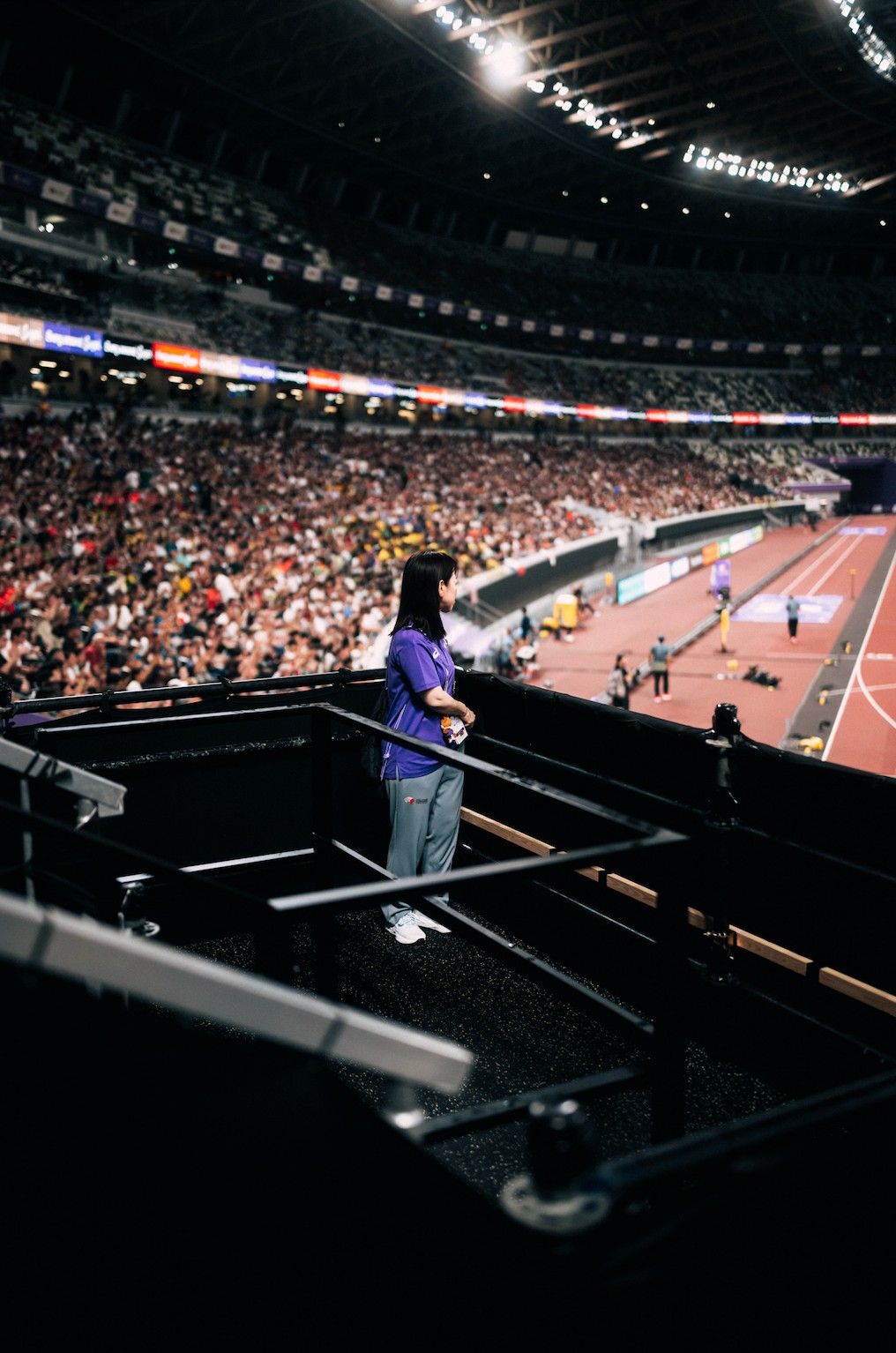


Fast forward to September 2025. International athletics competitions were back in the Japan National Stadium for the World Athletics Championships – but, this time, the multi-coloured seating wasn’t on display. Instead, for almost every one of the 14 sessions, 65,000 people filled the space with their own colour and noise. Athletics in Japan was literally and figuratively back on track.
As the first day of the World Athletics Championships approached, Yuko Arimori, President of the Japan Association of Athletics Federations, held a joint press conference with Sebastian Coe, the President of the International Association of Athletics Federations, and Mitsugi Ogata, the Head of the Championships. The importance of bringing athletics back to Japan was underlined by how emotional Yuko became when she explained that “This was supposed to be the venue of the Tokyo Olympic Games. Sport is not just for athletes, it is for everyone to get together, to be energised, to enjoy.” Yuko went on to say that the Championships was an opportunity to eliminate the memory of the Olympic Games, “And everyone that will come here will realise that athletics is the mother of sports and it is something to ignite and energise people. This is the message that will be disseminated from these World Championships.” Despite her impassioned words, Yuko perhaps understated the message that the World Athletics Championships would deliver.
The Japan National Stadium sits alongside the Prince Chichibu Memorial Rugby Stadium and the Meiji Jingu Baseball Stadium in Tokyo, all three surrounded by the Outer Garden of the Meiji Shrine. This hub of sports is remarkably close to the heart of the city, just walking distance from the world-famous Shibuya Crossing.
For a city with such a limited supply of available space, it feels indulgent to have so much real estate dedicated to sports venues. But on a balmy night, as crowds of athletics fans – arriving by public transport, on foot or on bicycles – mill around the concourse, illuminated with floodlights and full of vendors and sponsors’ booths, it all makes sense.
And once inside the stadium, the sense that this World Athletics Championships would be something of a redemption for Tokyo after the Olympic Games was even more evident. The place was packed. And the levels of excitement for every event that filled the schedule – from the early qualifying rounds to the finals – was at fever-pitch level.

It was unusually hot in Tokyo for mid-September. In fact, it was the hottest summer on record, which, combined with extremely high humidity, made conditions for athletes and spectators alike somewhat challenging. But that wasn’t enough to dent the enthusiasm for the party. And what a party it was.
Down on the track, there was one extraordinary race after another. The men’s marathon was won in a sprint finish, that saw the gold and silver medallists separated by just 0.03 seconds (a slimmer margin than for the first two places in the men’s 100m final). Jamaican Oblique Seville won his nation’s first major championship men’s gold medal – in the 100m – since Usain Bolt took first place at the Rio Olympics in 2016. In the women’s 400m final, Sydney McLaughlin-Levrone won with a time just 0.18 seconds slower than the 40-year-old world record. Kenyan Beatrice Chebet won both gold medals in the women’s 5,000m and 10,000m. Melissa Jefferson-Wooden became only the second woman to sweep the gold medals for the 100m, 200m and 4 x 100m relay since Shelly-Anne Fraser-Pryce, who retired at this championships after a remarkable career. And that’s just a few of the highlights.
Since the first World Athletics Championships – held in Helsinki, Finland in 1983 – this competition has been many things. It has been a proving ground for athletes hoping to compete in the future on the biggest athletics stage in the world: the Olympic Games. It has been a chance for athletes to prove that their successes or failures at the Olympics did not define them. It has been a chance for athletics fans to celebrate everything that is great about the sport in a dedicated major championship. And, in the case of the 2025 World Athletics Championships, it was a chance for a city and a nation to shake off the disappointment of an Olympic Games that will forever be remembered for its empty stadia. This year, no one in the cauldron of noise that was the Japan National Stadium would have noticed the multi-coloured chairs – because there was not a single empty seat when athletics made its return to Tokyo.

In partnership with
