The Valley Holds

Words by Like the Wind – Photography by Louis Bertrand
Not every iconic race starts with a grand vision. Some just start with a mountain, a path, and enough people willing to run uphill. What keeps drawing the world’s runners – and the people who back them – to this particular valley, every late June, is a story best told from the inside.
A Race Rooted In Place
There is a moment Fred Comte describes that captures something essential about Chamonix. It is the end of June, the trails are thick with rhododendrons in bloom, and the Mont-Blanc massif looms white and vast over the trails. “When you’re running on those paths in late June with the rhododendrons flowering and the snow-covered mountain in the background,” says the director of the Club des Sports de Chamonix, “those are images that stay with you.” He’s been at the helm of this organisation since 2006, long enough to remember when the word ‘trail running’ didn’t exist in French. Long enough to have watched his local mountain race grow into one of the most anticipated events in the trail calendar. “We believe trail running is, above all, a deeply human story, one built around people, shared values and all woven into the fabric of nature.” Bruno Laroque, Senior Marketing Director EMEA at New Balance, could have been describing the Marathon du Mont-Blanc specifically.
The race began, modestly enough, in 1979 as the Cross du Mont-Blanc: a tough, competitive, uphill race that served as the summer fixture for anyone who grew up running in the valley. Back then, the ethos was purely performance – you raced for your time, for your place. The finish-line culture that defines modern trail running, the shared experience of simply completing something extraordinary came later. Today the event spans eight races across four days, from the Mini Cross for children aged seven to fifteen to the full 90km ultra trail that departs before dawn. Around 10,000 runners from 85 nations descend on Chamonix, accompanied by some 30,000 supporters. Nearly 1,000 volunteers – many of them local families with generations of involvement – hold the whole thing together.
What hasn’t changed is the mountain. The trails are maintained by a team of more than 20 experts employed by the Chamonix municipality, clearing paths that were once mule tracks leading to the high summer pastures. The terrain is demanding by nature – Chamonix sits in a deep glacial valley, steep on both sides – but rewards the effort with views that few races in the trail world can match.
A Partnership Built On Shared Values
New Balance arrived as title partner with a stated intention not to overwrite any of this. Bruno puts it plainly: “The race is led by passionate people and a non-profit organisation with a genuine mission, to celebrate outdoor sport while protecting the natural environment of the valley. That mindset strongly resonates with New Balance.“ The shared heritage didn’t go unnoticed either. The Club des Sports de Chamonix was founded in 1905; New Balance in 1906. Both institutions, over a century later, still operate with a long-term independence that sets them apart from much of the commercial sports world.
For Fred, the partnership has brought something less tangible than logos and kit. “When we started talking to New Balance, we immediately felt we had the same philosophy – people who wanted to do things well, without overstating it, without wanting to change the event. We got along very well.” He pauses, then allows himself a smile. “It’s a bit like meeting someone new after a long relationship. Suddenly, you have energy again. It’s put a real smile back on our faces.”
Bruno echoes the sentiment from the other side: “We see our partnership with the Marathon du Mont-Blanc as a long-term commitment. Together, we want to elevate the experience not only for athletes, but also for spectators, volunteers and the entire Chamonix community who make this event so special.”
Chamonix As Home Base
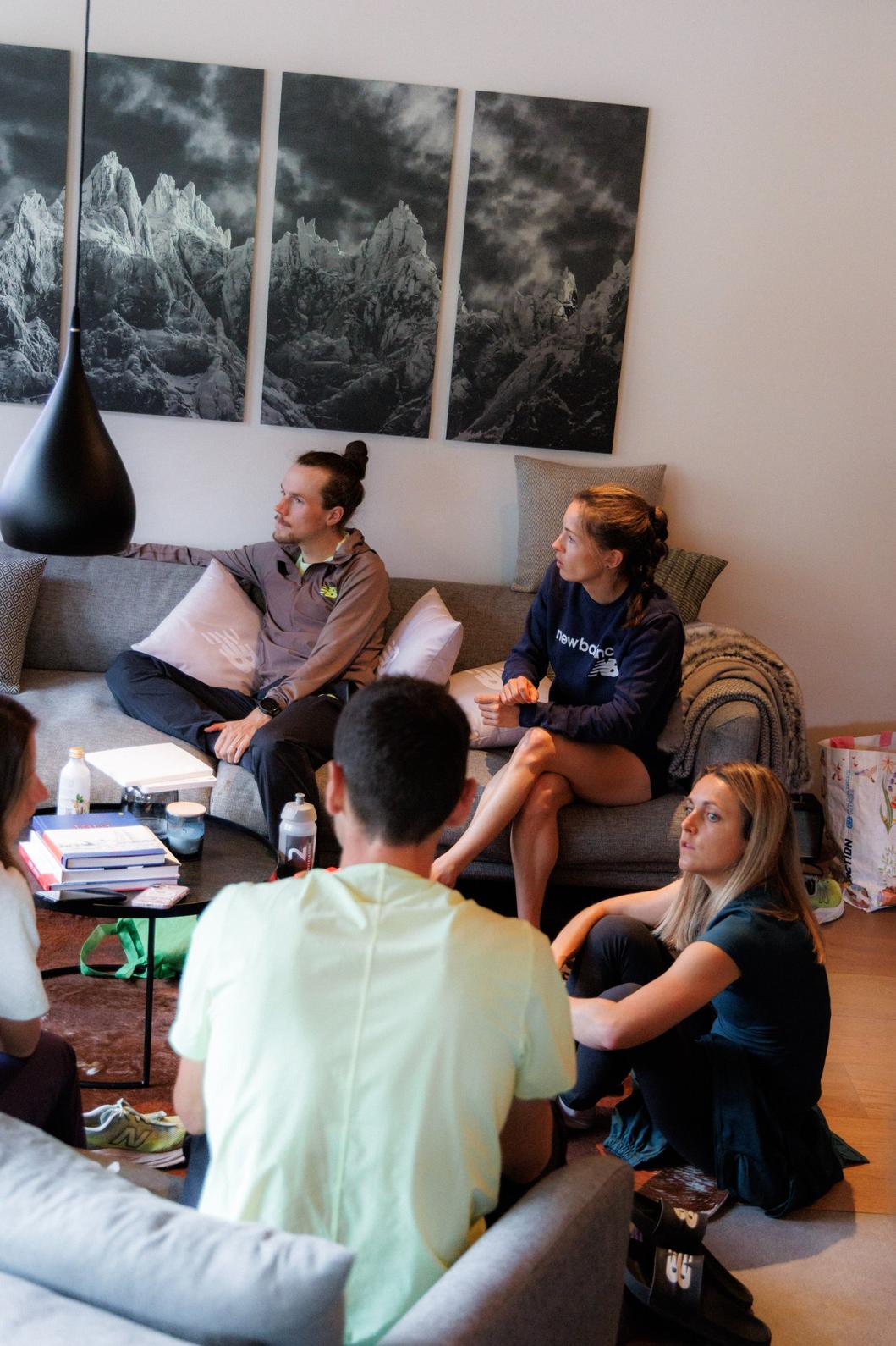
Part of what makes the New Balance approach distinctive is the athlete house. The brand rents a cluster of three interconnected chalets in Chamonix, available not just for the official May training camp but for athletes to use throughout the season, on their own schedule. The idea is that Chamonix becomes something more than a race venue: a base, a reference point, a place to return to. Less organised retreat, more open-door summer camp – the kind of place where what matters is who shows up, not what’s on offer when they do.
Alice Bausseron, 25, is one of those athletes. She grew up near Albertville, took a job as a mountain hut warden in the Beaufortain Alps because she had always wanted to work at altitude, and has recently added a small potato-growing operation to her schedule – running it part-time alongside a café job that keeps her mornings free for training. She is not a professional athlete in any conventional sense, but she is a serious one. “Running is a way of life for us here,” she says. “You go out, you do ski touring in winter, you spend time outside. My partner runs too, so we share those moments. The performance is becoming more important, yes – but the pleasure of being outside comes first.”
The race weekend itself, with its huge crowds, is almost overwhelming for someone from a small mountain village. The chalets are a different matter. “It’s a real opportunity,” she says. “I’m genuinely grateful to be able to live that experience.” What she values most is the group dynamic: athletes from different countries and disciplines training together, cooking together, cheering each other on during races. “Everyone pulls everyone else upward. Even if we’re running the same race with similar targets, we all want each other to do well.”
The Ones Who Still Have Day Jobs
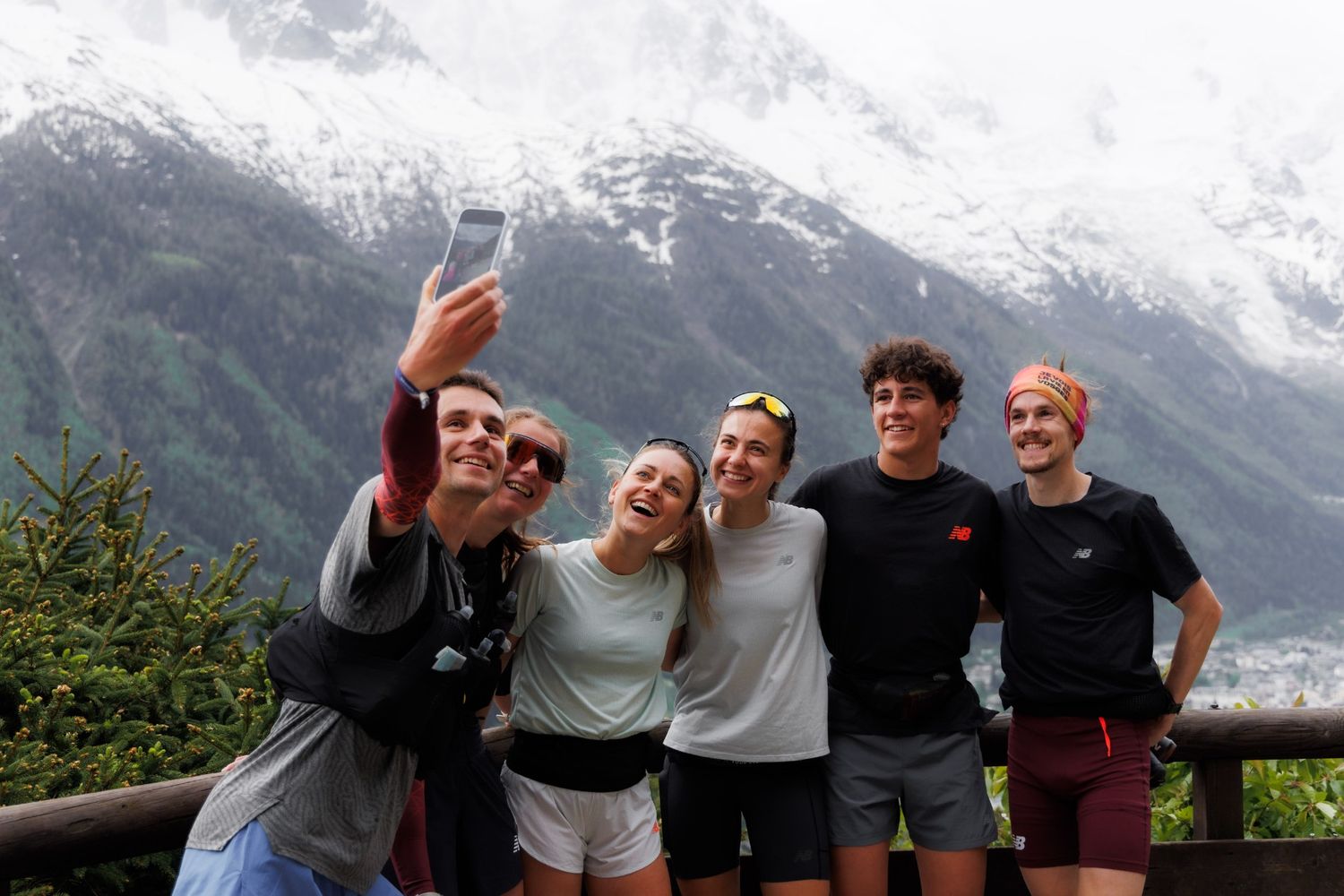
Benjamin Polin, 31, offers a different kind of profile. He’s from the Vosges, works full-time for a local authority in the energy transition sector and trains twice a day around it – a lunchtime run and a longer session in the evening.
He has been selected twice for the French 100km road team, yet still thinks of himself, with some amusement, as an amateur. “Most people don’t know I have a full-time job,” he says. “If you only look at the results, you wouldn’t guess.” Trail running, for Benjamin, has always been a passion first – something he has built a life around rather than built a career from. Joining the New Balance team this year felt less like turning professional and more like finding his people.
Like Alice, Benjamin will be racing the 23km route at this year’s edition – the historic Cross du Mont-Blanc, the race that started it all back in 1979. His first week at the Chamonix chalet during the May camp left an impression. “It was genuinely exceptional – not because of anything fancy, but because of the people.” “You have athletes from across the world, all living the same thing, all completely invested.” “And me, I turn up like an excited kid because for one week I’m just training, no work, surrounded by people who get it.” He laughs. “I keep joking that I’m an amateur because I’ve been training 20 hours a week for 10 years. But the joy is still there. That matters.”
The contrast between Alice and Benjamin – one shaped entirely by mountain life, the other discovering high-altitude running as a student and returning to it every year from the rolling hills of the Vosges – reflects something fundamental about the New Balance team as a whole. It spans nationalities, disciplines, ages and circumstances. What holds it together, according to both of Alice and Benjamin, is less the brand and more the place. Chamonix does something to people.
What The Mountain Gives Back
Fred, who has watched trail running evolve from a niche mountain discipline into a global movement over more than two decades, ends with a thought about what the race is actually for. “We’re an association,” he says. “Every bit of energy and every Euro goes back to the athletes and the event.” “We’re not a company. We don’t need this to make money.” “That changes things quite a lot.” For a sport that sometimes struggles to reconcile its counter-cultural roots with its commercial present, that might be the most important thing the Marathon du Mont-Blanc has going for it.
On the last weekend of June, the valley will fill again. The rhododendrons will be in flower. The chalets will be busy. And somewhere on the trails above Chamonix, a part-time potato farmer from the Beaufortain Alps and a full-time civil servant from the Vosges will be racing in the shadow of Mont-Blanc – as part of a team that considers Chamonix home. ∎
In Partnership with

newbalance.com