Raise the Bar
How Two Female Creatives Set Out To Tell The Story Of Women At Western States – And Ended Up Making Something For Everyone.
Words By Like the Wind – Photography By Hilary Yang and Carrie Highman
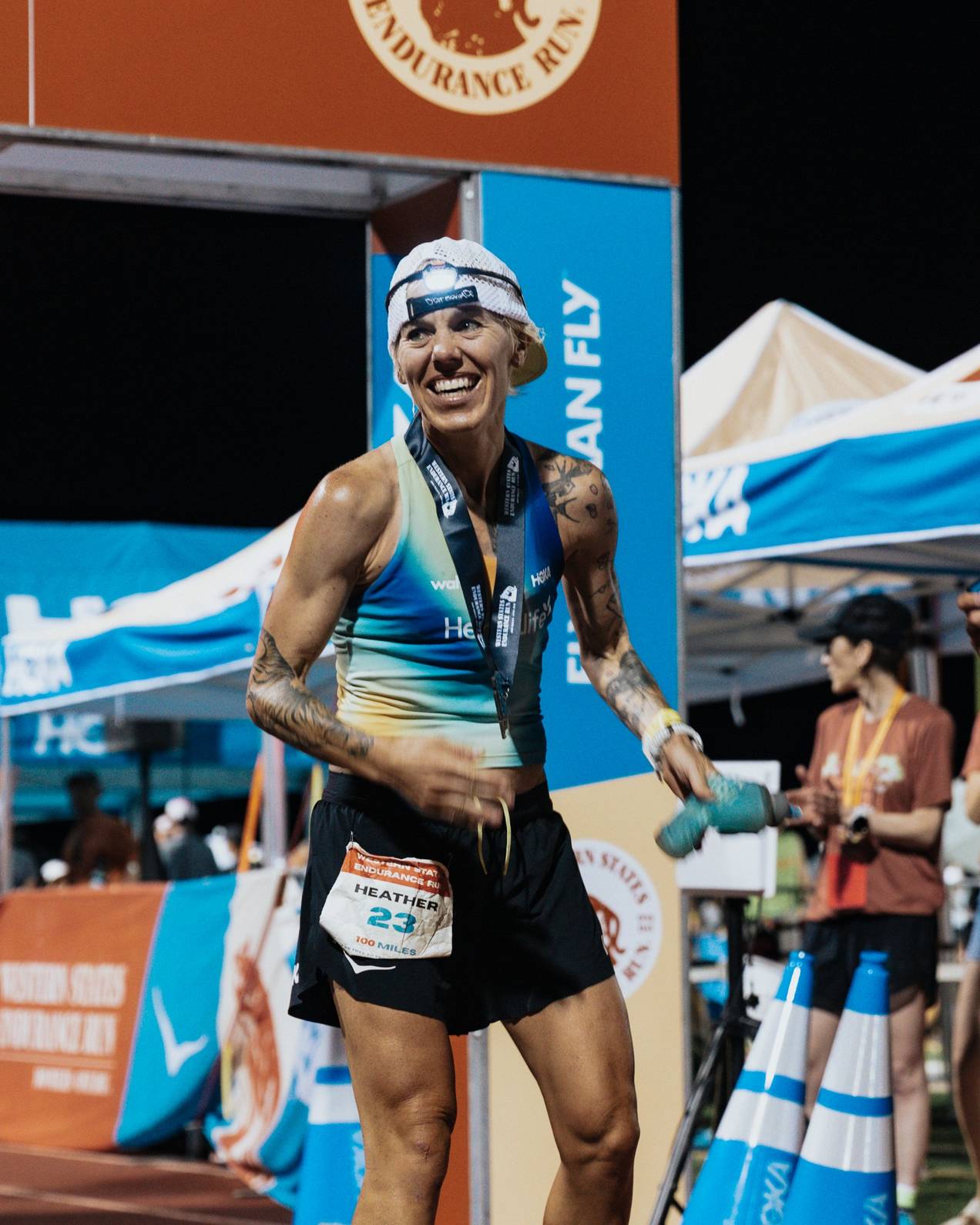
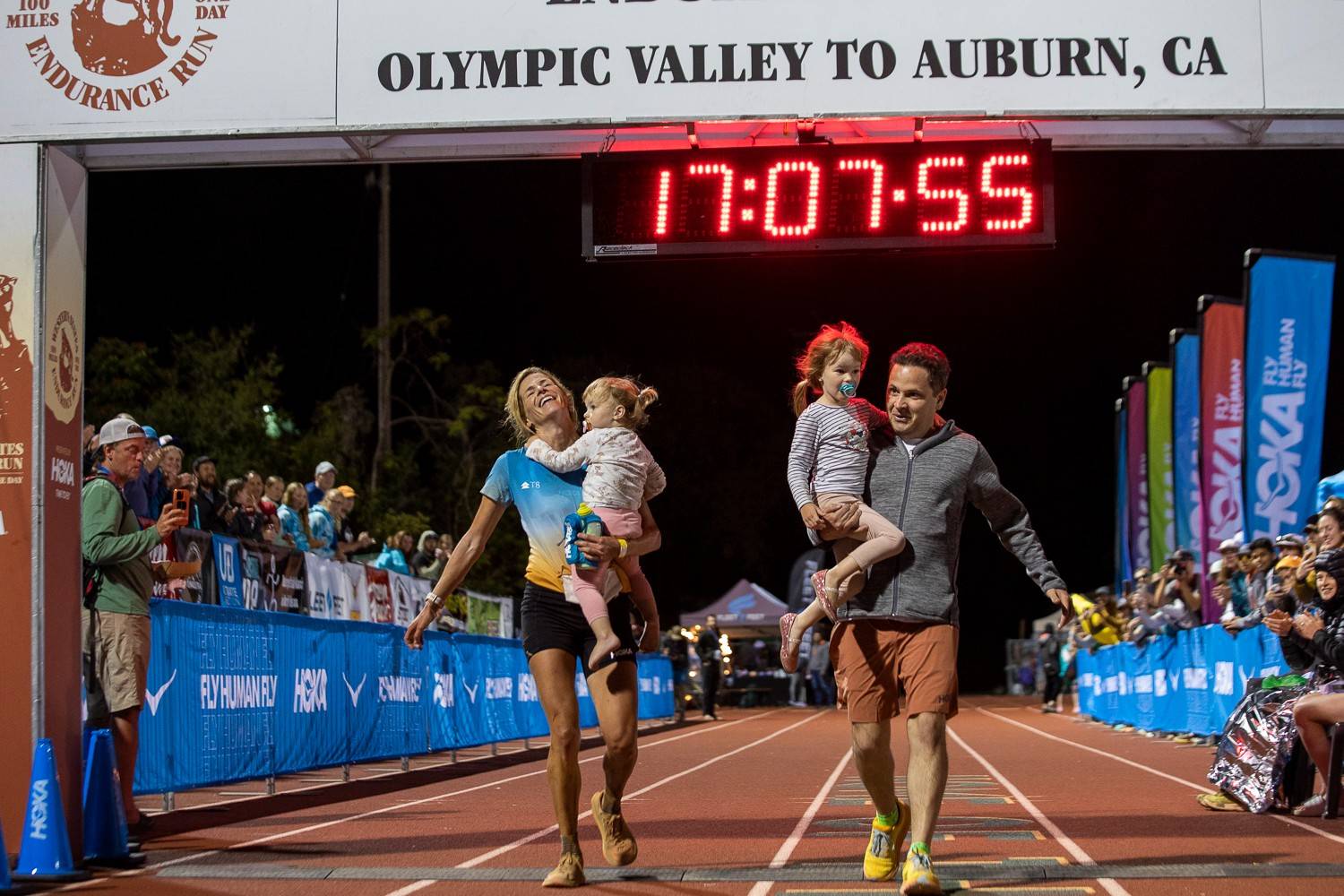
There is a moment in Raise the Bar – the new film by Hilary Yang and Carrie Highman, made in partnership with HOKA – when a runner crosses the finish line at the Western States Endurance Run, collapses onto her back, and looks up at Abby Hall. Exhausted, wrecked, completely spent, she manages one question:
“Did you win?”
It is, as Like the Wind‘s Simon Freeman puts it in an interview with Hilary and Carrie, “the kind of moment that gets dust in your eye”. It is also, in three small words, the whole point of the film.
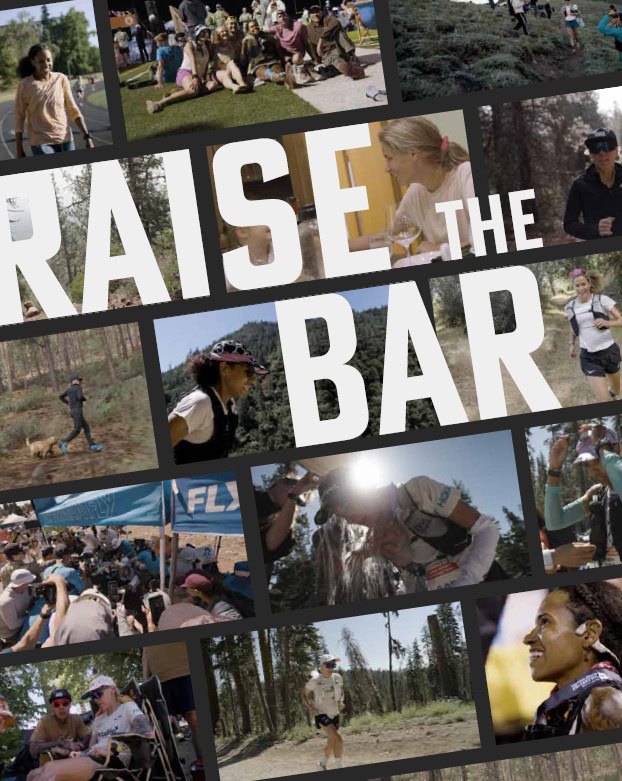
Raise the Bar arrives at a moment in women’s trail running that’s both historic and quietly revolutionary. The 2025 Western States women’s field was, by general consensus, the deepest it has ever been: a constellation of elite athletes from across the globe, none of them previous winners, any of them capable of taking the tape. The film follows four of them (Heather Jackson, Fu-Zhao Xiang, Eszter Csillag and Cindy Shepard) from their home training grounds to the canyons of the Sierra Nevada. It weaves their stories into a broader tapestry of the race’s history, the women who shaped it and the culture that continues to sustain it. The result is moving, exhilarating, and – crucially – brilliant on its own terms as a piece of filmmaking.
A Blank Slate, Anyone’s Game
The genesis of Raise the Bar was, in Hilary’s telling, a kind of frustration.
One of trail running’s most recognisable creative voices, Hilary is a photographer, race director, co-host of The Trail Network Podcast and a competitive ultra runner in her own right. Originally from Vancouver and now based in Los Angeles with her husband, filmmaker Billy Yang, she has spent years documenting the sport she loves and watching who gets documented. In the spring before the 2025 race, she noticed a pattern. Enormous buzz was building around the men’s field at Western States while the women’s field, at least as extraordinary by any objective measure, was an afterthought.
“I kept hearing, ‘Well, there’s no one obvious person to focus on,’” Hilary says. “And I started thinking: isn’t the exciting part the fact that there are 15 women who could win? We’re not in an era anymore when it’s just one person who’s going to lead the charge. To me, it was: how exciting is it to have this blank slate? Anyone can take it – and that is the story.”
Within days of conceiving the pitch, Hilary had called Carrie. The two had known each other through the world of female-forward outdoor storytelling. Carrie is the filmmaker behind Free to Run, which explores the barriers faced by women in Afghanistan, and Off Course, which premiered at the Banff Film Festival and examines infertility, identity and ambition. Hilary knew instinctively that this story would be richer, more powerful and more fun with another woman alongside her. She was right. HOKA greenlit the project within a week and a half. The cameras started rolling almost immediately.
Guns Blazing into the Archive
Carrie’s response to Hilary’s pitch was immediate and physical.
“I got goosebumps when she pitched me on it,” she says. “I figured that was a really good sign.”
Months of research, travel and interview followed, including hometown visits with each of the four main characters; a trip to China to film Fu-Zhao Xiang racing in her own environment; time spent with Eszter Csillag in Hong Kong; and a deep dive into the archives of a race that stretches back to 1974.
The history component turned out to be one of the film’s most revelatory elements. Hilary and Carrie went in expecting to uncover a familiar story – women fighting for their place at the starting line, struggling against an establishment that didn’t want them there. But they found something more nuanced and, ultimately, more heartening.
“Western States started in 1974,” Hilary explains, “the same year the Boston Marathon first officially allowed women to run. But the trail was different. The horse race in Western States lore was already a broadly equal sport and that culture transferred into the running. What surprised us was that in the context of Western States specifically, the attitude was often: ‘Why is this even a question?’ And I think because of that, we’re not telling a story of changing Western States – we’re showing how the rest of the world is catching up to something that was already there.”
That spirit – women not breaking down doors but walking through ones that were already open, or prying open the few that weren’t – runs through the film’s historical sequences like a bright thread. The co-founders of the race itself were women in their twenties: young, passionate, just doing the thing. The film honours them, not retroactively but as living links to the present.
The Village It Takes
One of the more unexpected dimensions of Raise the Bar is the space it makes for Cindy Shepard, a Portland runner for whom Western States was a first. Hoping simply to finish, not expecting to podium, she wasn’t sure how her story would fit alongside those of athletes like Fu-Zhao Xiang and Eszter Csillag.
That uncertainty, Hilary and Carrie agree, turned out to be the point. The film highlights how the community that gathers around a finish line at Western States, whether you’re at the front of the race or ten hours behind, is bound together by a single shared truth: you are always, ultimately, at war with yourself on the trail.
“The bonding bit of ultra trail,” Carrie says, “is knowing what it’s like to battle yourself out there. That’s what makes the community so special. Because everyone’s supporting these athletes, whether it’s Cindy on her first Western States or one of the elites, because at the core of it, everyone knows what it is to be out there and see what you can do.”
The film expanded from a planned 40 minutes to a full 90, because Hilary and Carrie kept finding more they couldn’t bear to cut. The language challenge of incorporating Fu-Zhao’s story (conducting interviews between English and Mandarin, editing subtitle translations frame by frame) became one of the project’s proudest achievements.
For Everyone, By Women
In backing Raise the Bar, what HOKA understood is that the most powerful stories about women in sport are rarely the ones that announce themselves as such. The film does not plead its case or ask for special dispensation – it doesn’t have to. It simply puts extraordinary women at the centre of the frame and trusts the audience to follow. The outcome is a great film about great racing.
There is still ground to cover. At Western States, women make up around 24% of starters – one of the higher rates for a 100-miler – but still a number that tells its own story. At events like UTMB, the figure drops to around 10%. The film is, among other things, an invitation – to the runners who haven’t yet seen themselves in the field and to the brands and organisers who haven’t yet fully understood what’s at stake. And it is an invitation extended warmly, generously, without rancour.
Carrie frames it with a filmmaker’s clarity.
“As we carve space as female filmmakers,” she says, “how can we start opening the door for more women coming behind us who also want to be telling stories in this space? How can we take some of this energy from these athletes and do that in our creative industry as well?”
Hilary and Carrie are already working on a stack of new projects.
The story, it turns out, is just getting started. ∎
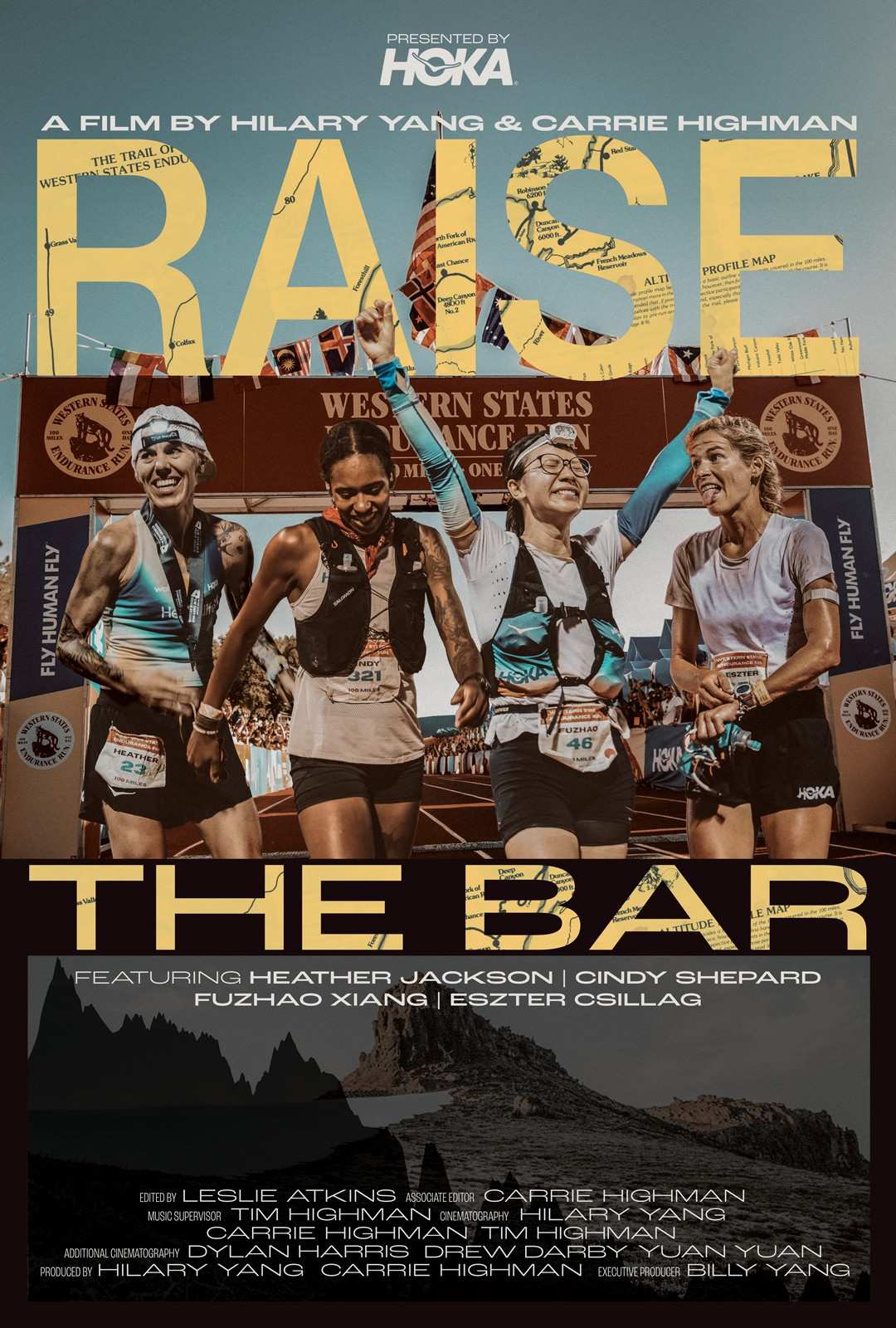
Raise the Bar is a HOKA original film directed by Hilary Yang and Carrie Highman.
www.raisethebarfilm.com
In partnership with
hoka.com