

The Road to Redemption
The Road to Redemption
Words by Like the Wind – Photography supplied by Dan King
Who is Mikey Kratzer? If you ask the man himself, he’ll tell you that it depends on when you got to know him – because Mikey is a changed man. Through his rebellious teenage years and into his twenties, Mikey was a musician and DJ who threw himself into the party lifestyle. But meet him today and you’ll encounter an athlete with a marathon personal best of 2h39m55s and a burning desire to challenge himself physically and mentally on the roads, on forest trails, in the mountains and across deserts.
And it was in the desert between Los Angeles and Las Vegas that Mikey decided to tackle perhaps his biggest challenge. One that would prove too much the first time he attempted it – and just enough the second time.
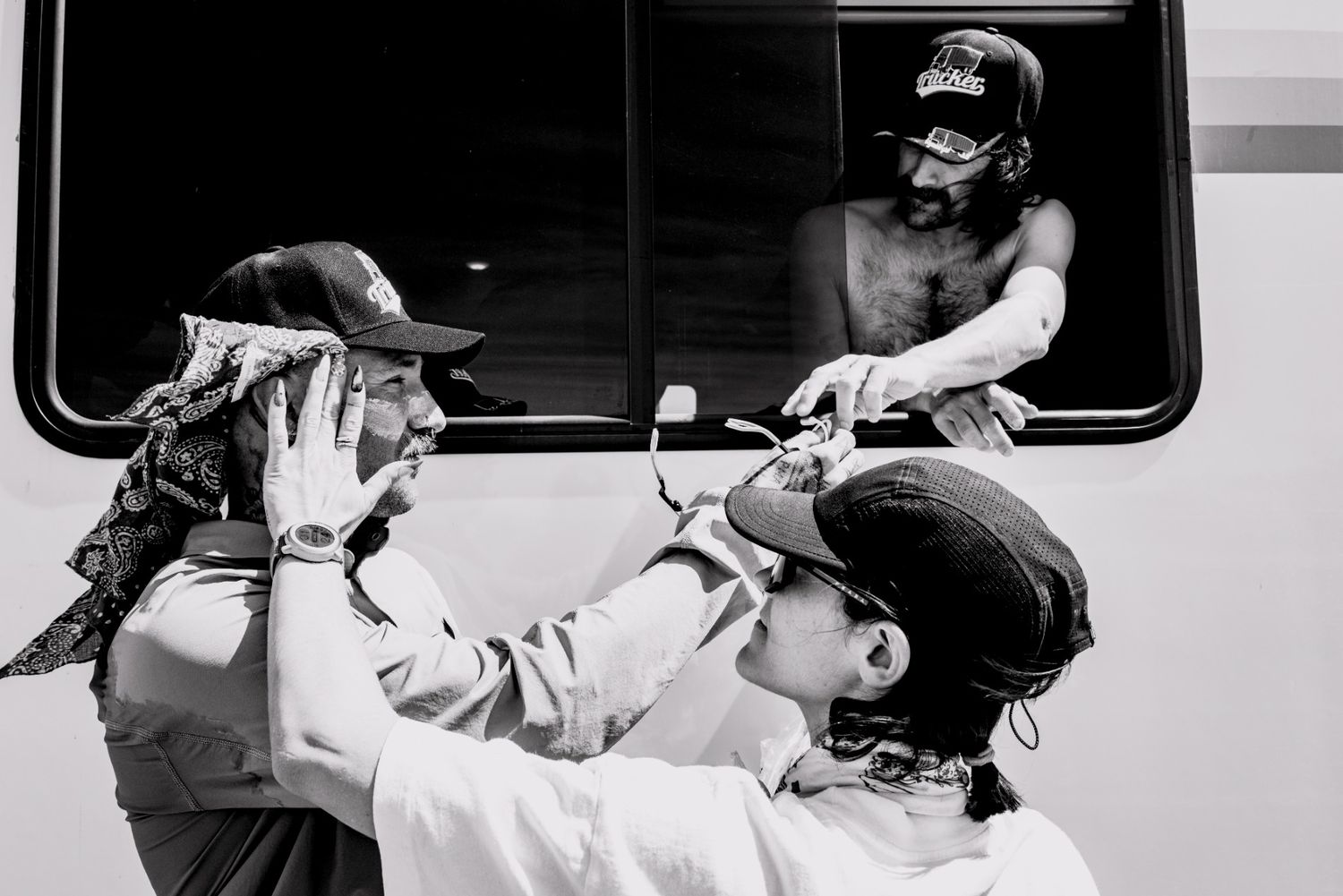
On 24 March, Mikey set off from Los Angeles to run the Speed Project solo – around 550km with no fixed route (hence there is no fixed distance) and no aid stations – with his support team and a film crew of two supporting from an RV. This was a return to the challenge at which he failed in 2024. The film – called The Picture Of Mikey Kratzer – was made by production company Get The Skinny and follows Mikey as he pushes himself again to achieve more than he thought possible.
Mikey’s story is about how change is a process. It’s about how running is enough by itself, but having a reason for all the time and effort it takes is also important. And it’s about how the combination of a punk attitude and an organised way of life is the secret sauce for being a great runner. … at least it is for Mikey.

LtW: What’s one thing that people misunderstand about Mikey Kratzer – perhaps from what they see online or in media?
Mikey Kratzer (MK): Online, as most people know, is like a highlight reel where I’m at a lot of races or on adventures. But my day-to-day life, due to the kids and everything else, is slightly less chaotic and more organised. My wife has a tattoo shop that needs a lot of time. So as wild and crazy as it sometimes seems, it’s a pretty boring life most of the time.
LtW: In the film just released about your solo Speed Project run from Los Angeles to Las Vegas, you talk about how you were a sporty kid. And then as you got into your young adulthood, you became a bit of a party animal. When you decided that you were going to find this sporty kid again as an adult, why did you pick running?
MK: Well, initially it was cycling. But due to the kids, time-wise it had to become running because running is the easiest [sport] that you can squeeze into day-to-day life. So it wasn’t really by choice. The simplicity of running was the selling point. You can do it whenever you want. More or less, you just need a pair of trainers and shorts and that usually does the job. You don’t need to really plan a route. Like, if you’re stubborn and you want to run, you can run around your block. So the simplicity and freedom of running [is the attraction] because you can run however you want.
LtW: Another thing that you talk about in the film is that you quit drinking. You quit drinking the day after your wedding day, right? How important are these momentous points in time for you? Why was it important that you picked a day like your wedding day to say, “I’m going to quit drinking”?
MK: With the wedding, it was easy. Because [my wife and I] had been vegetarian or vegan for a while. And you always get comments about not being able to eat stuff, but I can eat whatever I want. I just don’t want to. And it was the same with drinking. If I had stopped drinking three months before the wedding party, there would have been people asking why I wasn’t drinking. And to avoid that, I said, “Hey, I’m already over it. But this will be the last big party where we go all out.” Since that night, I don’t know any social occasion where I really get peer pressured into drinking anymore.



LtW: Is there something similar with running? That you can draw something out of yourself because of the momentous nature of certain moments in running?
MK: Yeah, definitely. In the film, I say at the end that I just need running. I don’t need marathons. I don’t need any of that – other than moments of self-reflection or challenging myself. That’s the only reason why I want to get faster in the marathon: not to have a better result, but to prove to myself that all the time I dedicate to running is going somewhere. Which is absolutely stupid. Because nobody cares. But for me, the way I [engage with] running is really time consuming. So I need to have a point to work towards and to challenge myself to not get too comfortable.
That’s what running gives me. And that’s what drinking gave me before. Some sort of purpose. Because I was surrounded by people who [worked in] bars, so there was always a reason to drink. And now there’s always a reason to run. But it’s a way healthier leisure time experience than being on the booze all the time.
LtW: There are moments in the film that we absolutely love: one of them is the scene in which the film crew speaks with the guy at the burrito place. He represents most people in his incredulity of what you’re doing.
MK: Yeah, f*cking hell.
LtW: Do you recognise that what you do is abnormal outside of our running bubble?
MK: Yeah, you get reminded quite often. But the problem is that, at the point I am at now, most of the people I surround myself with are pretty much the same. There are discussions where [people say] “I ran 250km last week and I still need to do my 70km long run today” and nobody questions it. Which is crazy. But then I work in a little outdoor shop and if people find out what I do they’re blown away. Like, this morning a lady said to me that if she does 7km in an hour, she’s really happy. And she assumed that I’m much [younger] than her. But she’s only five years older than me.
When I started marathon running 10 or 15 years ago, breaking three hours was crazy. You were considered crazy if you broke three hours. Now you can run 2h28m and nobody cares. It’s not really [extreme]. It’s still fast and everything, but [expectations have] just shifted so much that back then it was a crazy achievement. Now it’s not even a side note, which is a crazy [thing] to think.

LtW: The film shows that you have a great approach to life, which certainly comes across in your running. In the film, you use the word ‘Vergänglichkeit’. The English translation is ‘transience’ or ‘impermanence’. And you talk a little about this idea of fighting against getting old. What are the cool things about getting old? Is one of them just having a bit of a sense of humour? Not getting too upset about things?
MK: Yeah, I think you have all that uncertainty in your twenties and thirties and you don’t really know who you are and who you’re going to be. But it doesn’t matter really, ’cause you find out. I turned 40 a couple weeks ago and I’m still in my prime running-wise. And even if I’m not, it doesn’t matter. So I think you don’t have that urgency anymore [as you get older].
I think there’s something cool about having trust in the universe. I think when you are younger, you take it way harder when sh*t hits the fan. You think that something is a dead stop. But there won’t ever be a dead stop in life. Other than actually being dead. Now I have trust that I’ll meet the right people at the right time. And that even if something bad happens, that it will still bring something good. And through that trust there’s no need to worry. So I crack jokes and I believe you can’t change [what happens] anyway.
You can be a guy who dedicates all his life to worrying. Sh*t will still happen, whether you worry or not. It’s just up to you to choose how you react to it. And I think that by reacting positively, usually the outcome will be somehow positive. That’s true in running and in life in general.

In partnership with
